

Minor Arcana · Wands
Seven of Wands Tarot Card Meaning
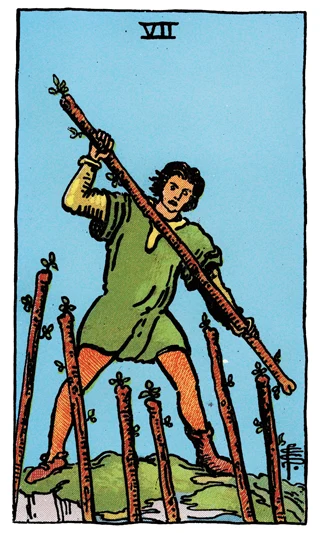
A figure stands on high ground, holding a wand defensively against six other wands rising from below, representing the need to defend your position.
Overview
The Seven of Wands asks you to defend a position after gaining ground. It is about boundaries and selective resistance, not proving yourself against everyone; a strong stance still needs evidence, rest, and a sense of which challenges deserve your energy.
Upright and reversed meanings
Upright meaning
Upright, this card shows pressure from competing demands or opinions and the need to maintain a boundary. Clarify what you are protecting, what evidence supports it, and which objections contain useful information. Standing your ground can preserve an important goal, but it does not require treating every question as an attack or carrying the whole defense alone.
Reversed meaning
Reversed, the Seven of Wands can reflect exhaustion, self-doubt, giving up too quickly, or defending a position long after its purpose has changed. You may lack resources rather than courage, or be so guarded that collaboration feels unsafe. Reduce the front you are holding, ask for support, and revise a position when the evidence—not just the pressure—calls for it.
Love and relationships
In dating or an established relationship, this card can highlight protecting boundaries from outside opinions, competing obligations, or pressure to move faster than feels right. Explain what you need without making your partner guess what is being defended. Reversed, constant defensiveness, jealousy, or withdrawal may be exhausting the connection. Ask whether the boundary still serves trust and whether both people are carrying it.
Career and work
At work, the Seven of Wands can describe pushback on a proposal, defending a role, or protecting quality under deadline pressure. Bring evidence and state the limit that cannot be compromised, then identify what can change. With money, protect a necessary budget or rate without treating every negotiation as a threat. Reversed, limited staff or resources may make delegation and scope reduction more responsible than endurance.
Yes or no tendency
yes
Upright, this card leans yes when the question concerns holding a boundary, protecting important work, or continuing with a well-supported position. It does not promise that resistance will disappear. Reversed, the tendency is maybe until you restore capacity or decide whether the fight is still worth its cost; a pause can be strategic rather than a defeat.
Practical advice
Name one non-negotiable, one point you can adapt, and one person who could share the work of protecting them. Use that distinction in your next conversation. A boundary is clearer when it includes what you will do, not only what others must stop doing.
Reflection question
- What am I protecting, and what would tell me that this particular fight is no longer necessary?
Use this card in a reading
A card meaning becomes more useful when it is connected to a clear question and real circumstances. Draw a focused card for love, career, or a yes-or-no decision.
Common questions
What does Seven of Wands mean in tarot?
Seven of Wands describes an archetypal energy rather than a fixed prediction. Its meaning changes with the question, position, surrounding cards, and orientation.
Is Seven of Wands reversed always negative?
No. A reversed card can point to blocked, internal, delayed, or excessive energy. It is an invitation to examine how the card is being expressed.
What does Seven of Wands mean for love?
In dating or an established relationship, this card can highlight protecting boundaries from outside opinions, competing obligations, or pressure to move faster than feels right. Explain what you need without making your partner guess what is being defended. Reversed, constant defensiveness, jealousy, or withdrawal may be exhausting the connection. Ask whether the boundary still serves trust and whether both people are carrying it.
Is Seven of Wands a yes or no card?
yes. Upright, this card leans yes when the question concerns holding a boundary, protecting important work, or continuing with a well-supported position. It does not promise that resistance will disappear. Reversed, the tendency is maybe until you restore capacity or decide whether the fight is still worth its cost; a pause can be strategic rather than a defeat.